
When guests ask us what they should do during a free afternoon on Msuna Island, our answer is often surprisingly simple:
Take a walk to the Big Baobab.
Leave the island through the entrance gate and follow the road for about ten minutes. Along the way, you will pass the local football field. Depending on the day, you may spot a game in progress, or a few four-legged GOATs quietly inspecting the sandy pitch while waiting for Msuna’s answer to Messi or Ronaldo.
There are no ticket offices, souvenir shops or tour buses. Just local life, open bush and the feeling that you are about to discover something special.
Then, almost unexpectedly, it appears.
A giant baobab rising above the surrounding trees.
Known locally as the Big Baobab, this remarkable tree has stood here for generations. Long before mobile phones, GPS and social media, people were already stopping here, resting in its shade and spending time beneath its branches.
Looking at the old names and dates scattered across the trunk, it is easy to imagine grandparents bringing their children here, who later returned with children of their own.
Today, guests of Msuna Island Lodges can still experience that same short walk.
Welcome to Zimbabwe’s Baobab Country
The countryside around Msuna Island lies along the middle Zambezi in Matabeleland North. It is a hot, dry landscape where baobabs appear on hillsides, beside dusty roads and throughout the open woodland.
Over time, we started calling this corner of Zimbabwe Baobab Country.
It may not appear on an official map, but once you have travelled through the area, the name makes perfect sense. Wherever you look, baobabs rise above the bush, their broad trunks and unusual crowns giving the landscape a character all its own.
The African baobab, Adansonia digitata, is one of the world’s most recognisable trees. During the dry season, it often sheds its leaves, leaving thick branches that resemble roots reaching into the sky. This has earned it the nickname the upside-down tree.
One traditional story says the baobab became so proud of its beauty that the Creator uprooted it and replanted it upside down.
Whether you believe the legend or not, few trees make a more memorable silhouette against the blue Zimbabwean sky.
Standing Beside a Giant
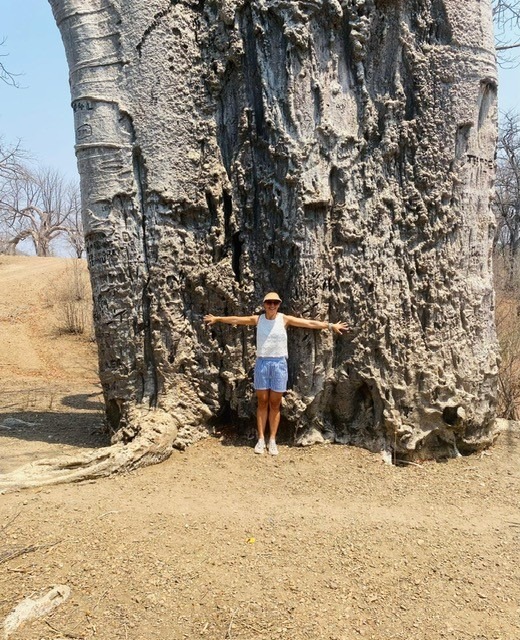
The Big Baobab near Msuna Island is impressive from a distance, but its true scale only becomes clear when you stand beside it.
The trunk is enormous. Its bark is folded and weathered, and its heavy branches spread above the surrounding bush.
People look tiny next to it.
Even our photographs cannot fully capture the feeling of walking around its immense base and looking upwards into a crown that has spread across this landscape for generations.
The tree does not need a grand entrance or visitor centre. A small sign points the way, and the Big Baobab does the rest.
Could the Big Baobab Be 1,000 Years Old?
No one knows the exact age of the Big Baobab near Msuna Island.
As far as we know, it has never been scientifically dated, so describing it as a 1,000-year-old tree would be speculation.
Still, such an age is possible for an African baobab. Some studied specimens have survived for more than a millennium.
Zimbabwe’s Panke baobab in Matabeleland North was estimated to be approximately 2,500 years old before its multiple stems collapsed.
The famous Big Tree near Victoria Falls has also been estimated at around 1,150 years old through radiocarbon research.
Size alone cannot reveal a baobab’s age because these trees can develop several stems and complex internal structures.
What we know for certain is that the Big Baobab has been a local landmark for generations.
Perhaps it is several centuries old.
Perhaps it is approaching a thousand years.
For now, the tree keeps its secret.
More Than a Photo Stop
What makes the Big Baobab special is not only its size.
It is also the experience of getting there.
The walk takes you beyond the river and into everyday life around Msuna Island. You pass the sandy football field, local homes and the dry bushland that defines this part of Zimbabwe.
By the time you reach the tree, you have experienced something many travellers miss: a small and authentic glimpse of life beyond the usual tourist routes.
The carvings on the trunk show that visitors have been drawn to the tree for a long time.
Today, the best way to protect it is to enjoy it without adding new marks. Take photographs, walk around it and leave the Big Baobab as you found it.
Experience the Big Baobab for Yourself
Come to Msuna Island for the Zambezi River, tiger fishing, birdlife and spectacular sunsets.
But leave a little time for a walk.
Ten minutes beyond the island gate stands a giant that has watched over this landscape for generations.
Walk past the sandy football field, follow the small sign and meet one of the quiet giants of the Zimbabwean bush.
Welcome to Baobab Country.
Welcome to Msuna Island.